

Big Four AI Arms Race
Two Firms Announce Major Alliances with Anthropic, PwC Faces $8.4B Evergrande Claim, EY Battles AI Hallucinations, Deloitte & EY Grapple with Parental Leave, KPMG Admits Confidentiality Breach

In This Issue
Anthropic & the Big Four — Major AI Partnership Developments
Deloitte — SCANA Settlement Finalized + Parental Leave Discrimination Lawsuit
EY — UK Partner Demotions, Canada AI Report Retraction, Australia Tightens Parental Leave
KPMG — Senior Partner Admits Misusing Confidential Client Files
Anthropic & the Big Four: The Arms Race is On
Over the last week, PwC and KPMG made major announcements about expanding their partnerships with Anthropic — PwC on May 14 and KPMG just yesterday on May 19 — and it’s shaping up to be a full-blown arms race among the Big Four. Deloitte got there early with its initial deal back in July 2024 and a major expansion in October 2025, while EY remains the only holdout, seemingly charting a somewhat different path.
Deloitte – The Early Adopter
Key Dates: Initial collaboration in July 2024; major expansion October 6, 2025.
Deloitte rolled Claude out to its entire global workforce of more than 470,000 people — Anthropic’s largest enterprise deployment at the time. They’ve built certification programs and are co-developing industry-specific solutions with strong compliance guardrails, focusing on regulated industries like financial services, healthcare, and public sector.
Clearly the firm’s approach has so far been using itself as a proof-of-concept of the benefits of AI, to then be able to credibly roll it out to clients.
PwC – Agentic Transformation
Key Dates: Earlier work in February 2026; major expansion May 14, 2026.
PwC is leaning hard into agentic AI, focusing on three core areas: building agentic AI systems for clients, incorporating AI into deal-making processes, and redesigning enterprise functions, with the “Office of the CFO” positioned as an early flagship application.
The multi-year initiative includes training and certifying 30,000 professionals (primarily in the US initially), rolling out specialized tools such as Claude Code (for agentic software development) and Claude Cowork (for productivity workflows integrated into documents, spreadsheets, and presentations), and establishing a joint Center of Excellence.
This direction signals a clear focus on deep transformation.
KPMG – Embedded AI
Key Date: Global alliance announced May 19, 2026 (yesterday).
KPMG is giving Claude to all 276,000+ employees and embedding it directly into core platforms via the new “KPMG Digital Gateway Powered by Claude” on Microsoft Azure. The firm has also been named Anthropic’s preferred partner for private equity and private capital markets.
Their main focus is building agentic workflows for tax, audit, advisory, and legal work — a move that plays directly to the immense strength of KPMG’s global tax practice.
EY – Sitting This One Out (For Now)
EY has made no major direct partnership announcement with Anthropic. Instead, the firm is doubling down on its own EY.ai Agentic Platform and alliances with players like Microsoft, NVIDIA, and Databricks. They remain very active in AI, especially in tax, risk, and finance transformation, but appear to prefer a broader, more independent ecosystem approach.
The AI Battle Ahead
This scramble isn’t surprising at all. Frontier AI like Claude is rapidly moving from experimental pilots to core business infrastructure, and the firms that can best weave it together with deep industry knowledge, regulatory expertise, and change-management muscle are positioning themselves for what looks like a massive wave of consulting and technology work ahead — the kind that will keep the next generation of Big Four partners very busy, and well compensated, indeed.
Evergrande Liquidators Seek $8.4 Billion from PwC
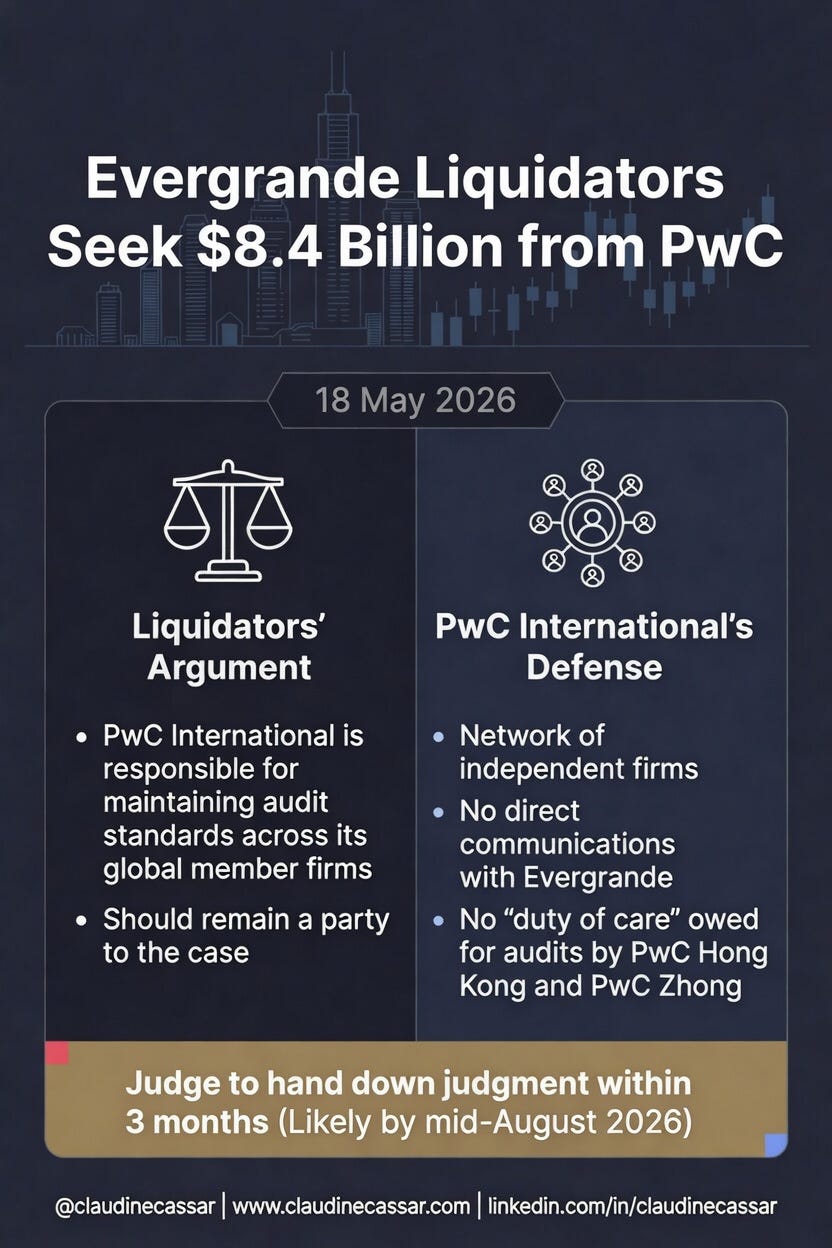
On Monday, the Hong Kong High Court heard the arguments for and against retaining PwC International as a defendant in the case brought by Evergrande’s liquidators, who are seeking 57 billion yuan ($8.4 billion) in damages from the firm over alleged negligent audits (primarily 2017–2020 financials, with focus on overstated revenues). Of the total, up to 38 billion yuan (~$5.5B) could apply to PwC International.
The firm has already incurred major penalties in relation to the Evergrande audits. PwC Hong Kong settled for HK$1.3 billion (~$166M) in fines/compensation in April 2026, while PwC China received a record 441 million yuan (~$62M) fine + 6-month suspension in 2024. The reputational damage has also been considerable, and ongoing, with two former PwC China partners involved in the audits detained under criminal investigation.
PwC International’s lawyer, Richard Handyside, argued that the global network entity was not involved in the failed audits in question, that Hong Kong/China firms are not its subsidiaries, and that it had no duty of care to Evergrande investors and other stakeholders. Liquidators Edward Middleton and Tiffany Wong (Alvarez & Marsal) countered that the international entity was nonetheless responsible for audit quality standards across the PwC network.
This case is shaping up as a major test of network liability for the entire Big Four — how much responsibility does the global coordinating entity bear for the work of member firms in high-risk jurisdictions like China?
Deputy High Court Judge Patrick Fung Pak-tung is expected to issue a decision by August.
Deloitte Finalizes SCANA Settlement
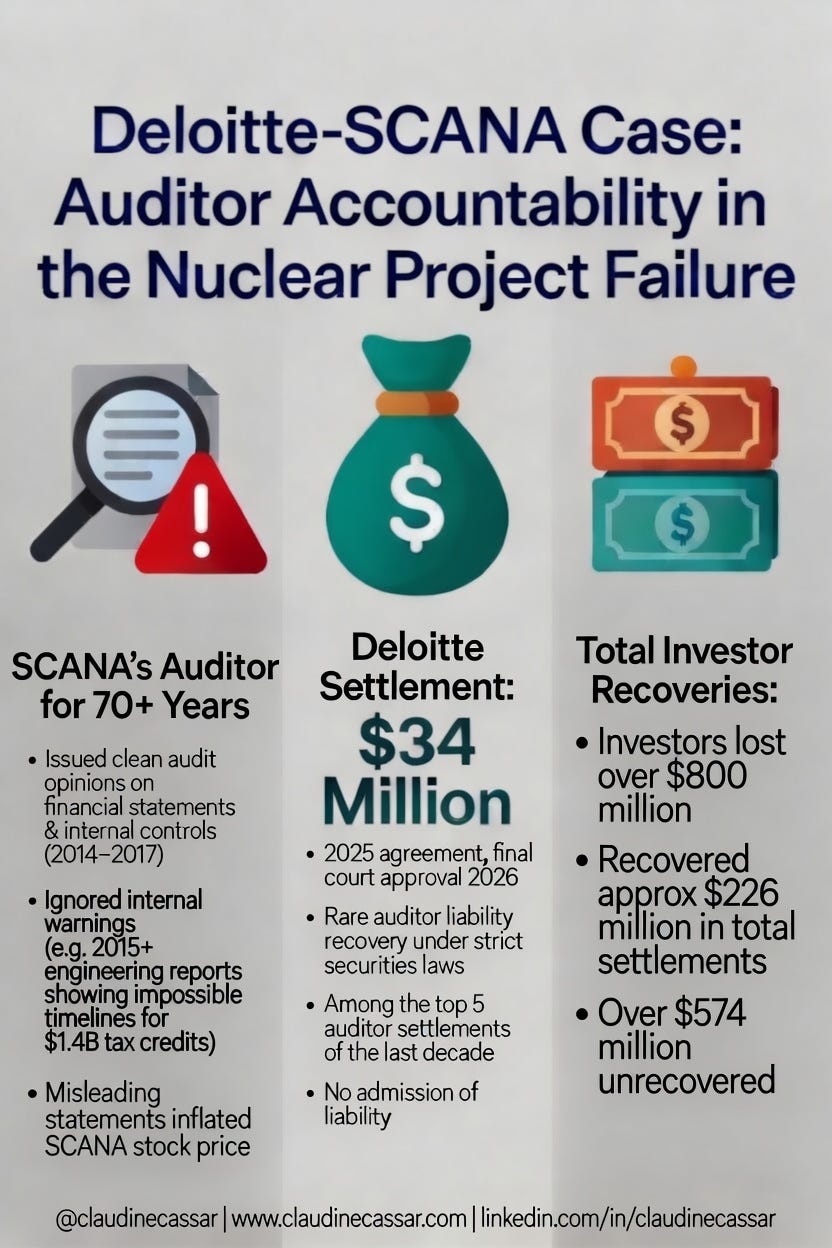
Deloitte has finalized a $34 million settlement with SCANA investors, resolving a six-year securities class action. The agreement, which received final court approval in March 2026, stems from claims that the firm’s clean audit opinions failed to flag major cost overruns and delays in the utility’s failed V.C. Summer nuclear project.
Notably, this outcome represents a shift from regulatory enforcement toward private litigation in the courts. Auditor liability cases have historically been extremely difficult for investors to win under securities law, making this one of the largest auditor settlements in the past decade and signaling growing potential for private actions to hold Big Four firms accountable when regulatory scrutiny eases.
Ex-Deloitte Employee Sues Over Parental Leave Discrimination
Joanne Kim Barela spent 13 years at Deloitte’s Human Capital Consulting practice, earning three promotions and consistently receiving “Strong” or “Exceptional” performance ratings.
She took approved protected leave in 2020 and 2024 for pregnancy-related conditions and newborn care. After both leaves, she returned to strong performance, receiving a $9,100 salary increase and a $37,700 bonus in 2025.
Despite this track record, Barela was terminated in December 2025 during a company-wide reduction in force. According to her complaint, her performance metrics were evaluated without accounting for her protected leave time, putting her at a disadvantage compared to colleagues who worked full years.
She has since filed charges with the California Civil Rights Department and the EEOC, and has received a right-to-sue letter.
EY UK Demotes Equity Partners
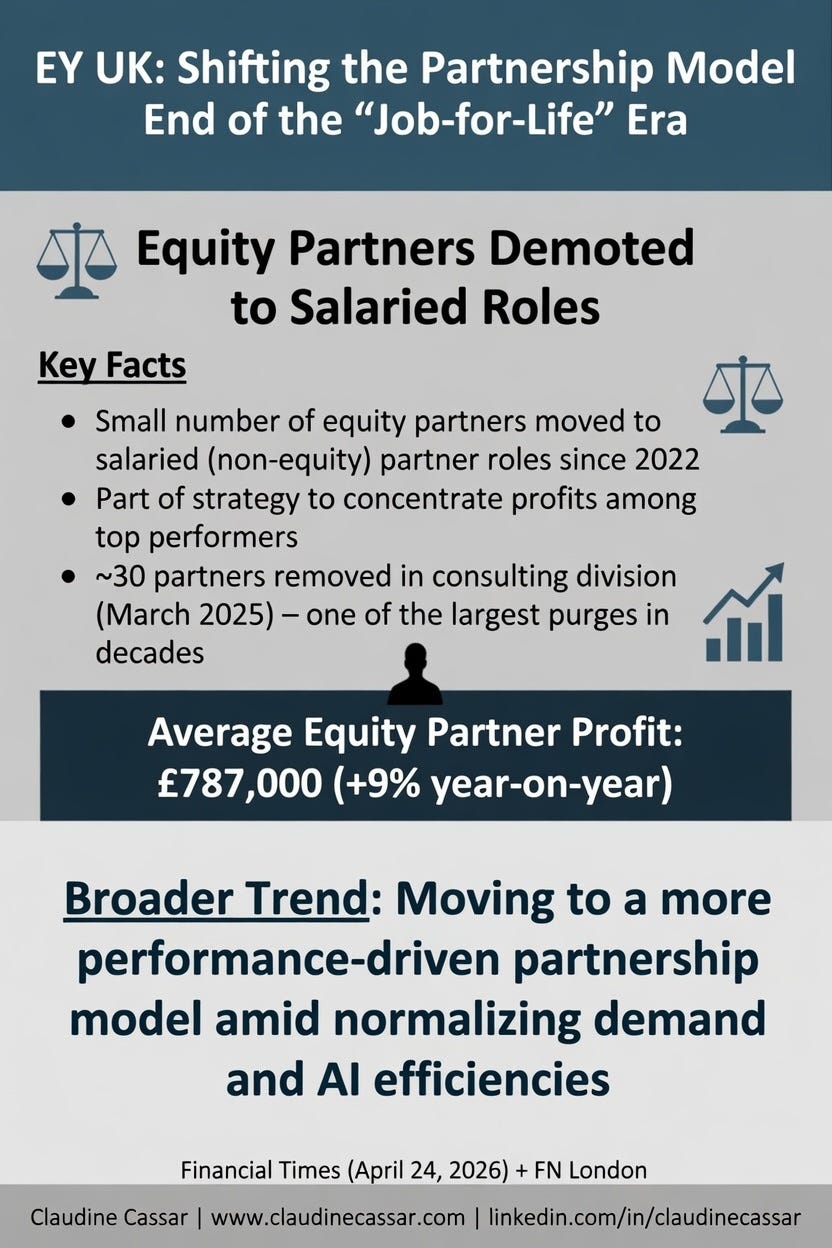
EY UK has demoted thirty consulting equity partners to salaried (non-equity) roles as part of a broader shift away from the traditional “job-for-life” partnership model. The moves, which have been ongoing since the firm introduced a salaried partner tier in 2022, aim to concentrate profits and rewards among top-performing partners amid slower growth and margin pressures in the UK market.
This quiet restructuring reflects a wider Big Four trend of prioritizing performance and profitability over tenure and loyalty, with affected partners retaining the title but losing access to the equity profit pool.
EY Canada Retracts Report after GPTZero Investigation Reveals Multiple Hallucinations
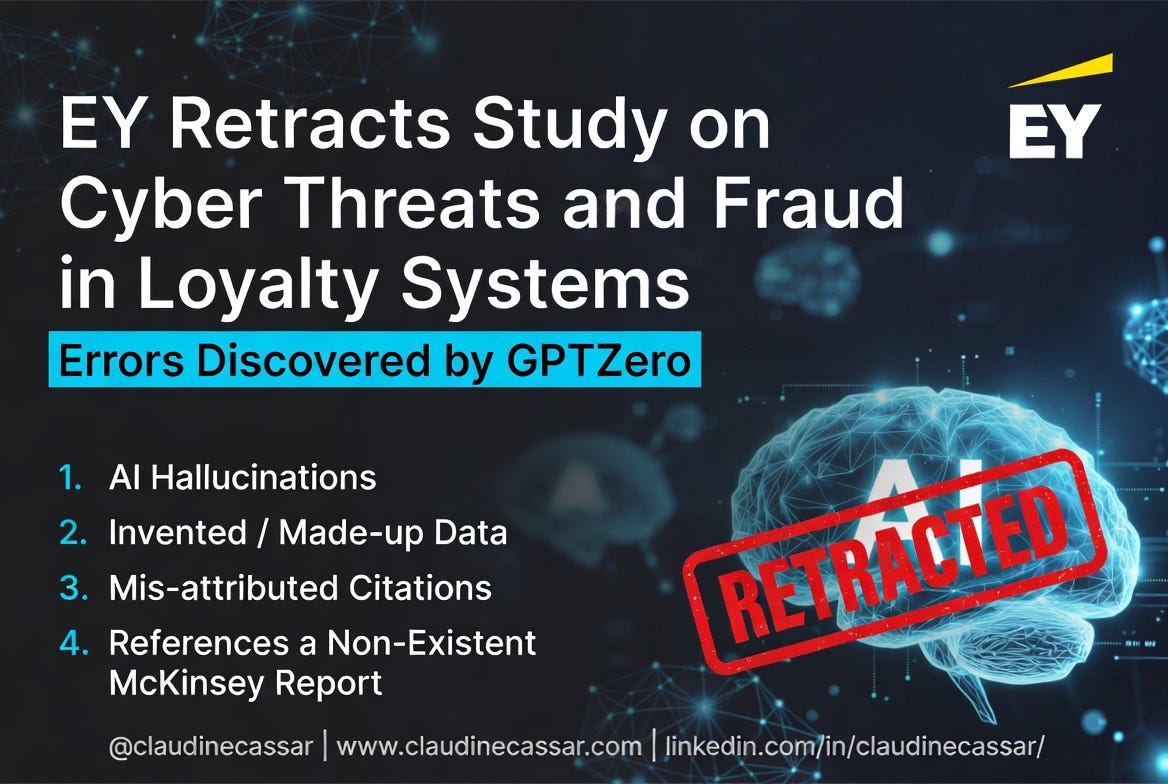
After the two AI faux pas made by Deloitte last year, which led to the firm having to retract reports in Australia (“Assuring Integrity in the Targeted Compliance Framework” report) and Canada (Healthcare Transformation Strategy), it is now EY’s turn to deal with an embarrassing case of AI hallucinations. The firm had to withdraw a report (“Points of Attack: Uncovering Cyber Threats and Fraud in Loyalty Systems”) after GPTZero conducted a detailed investigation that revealed the document was riddled with fabricated citations and inconsistent data.
Key Findings by GPTZero:
16 out of 27 references were hallucinated (broken or non-existent URLs)
References to a non-existent McKinsey & Company – Loyalty Economics Report (2022)
Made-up statistics and mis-attributed claims
The report was estimated to be 72% AI-generated
“Publishing a report online is essentially a form of data injection into the pool of knowledge that is the internet. When the report includes fake information (either vibed citations or false claims) it can ‘poison the well’ by misleading future researchers, especially if the report is published by a well-known consulting firm...”
The root of such problematic episodes lies in longstanding Big Four review habits. Partners routinely delegate research, drafting, and citation work to their subordinates, then perform only high-level reviews — assuming the team has done its homework on sources and data.
This model worked well enough in a purely human environment, but it is no longer fit for purpose in the age of generative AI, which can produce convincing but entirely fabricated references in seconds. Without updated vetting processes — such as mandatory citation audits, clear AI-use disclosures, and stronger partner accountability — these damaging episodes are likely to become a regular feature of Big Four thought leadership.
EY Australia Tightens Parental Leave Rules
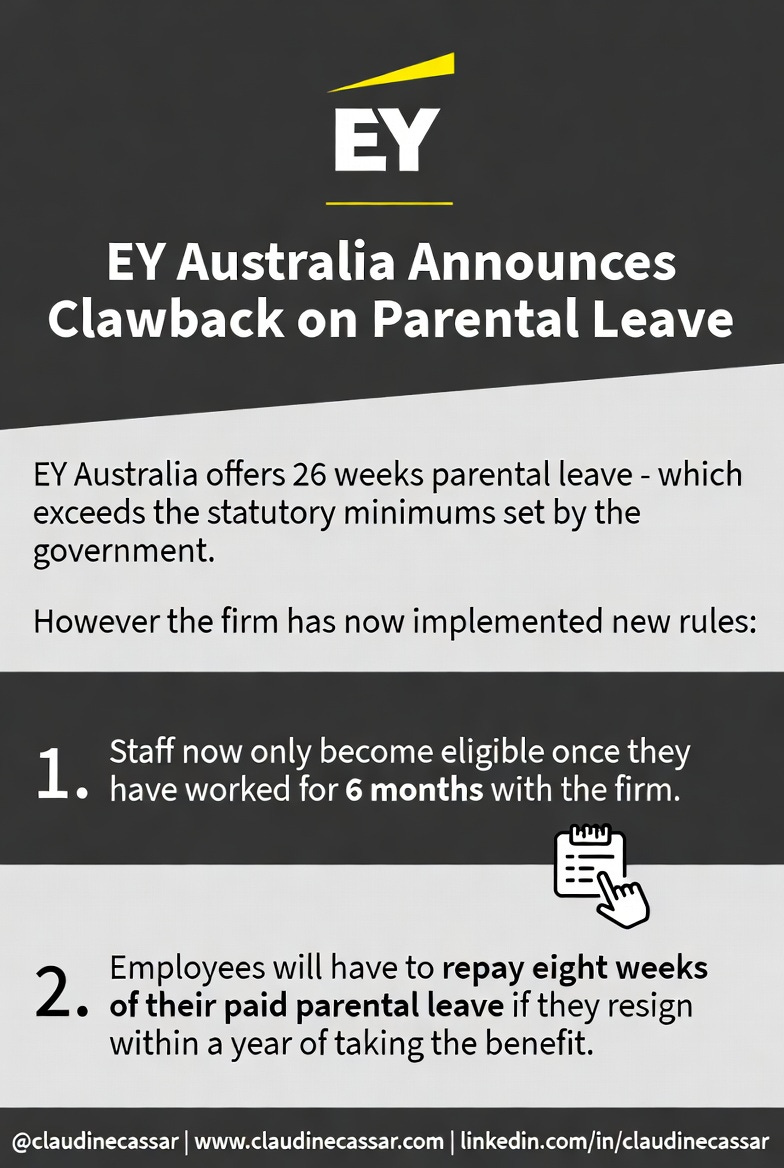
It’s not just Deloitte that has blipped on the radar because of parental leave this week. EY Australia has introduced stricter eligibility and return-to-work requirements for its 26-week full-pay parental leave policy for either parent, which is significantly more generous than the statutory minimum, which is based on minimum wage.
Effective 1 July 2026, employees must now complete at least six months of service before becoming eligible, and those who take 12 weeks or more parental leave must repay eight weeks’ pay if they resign within 12 months of returning to work.
The six-month service requirement is understandable. Without any eligibility period, there is a legitimate risk of the policy attracting short-term applicants primarily seeking the benefit.
However, the one-year repayment obligation is draconian. New parents — particularly mothers — can encounter unexpected challenges after birth, including postnatal depression, health complications, or childcare crises, which sometimes lead to resignation. While it may make financial sense for the firm to recoup part of the benefits in such cases, the policy sends a punitive and unsupportive message, particularly to long-serving employees.
Hopefully the backlash will encourage EY to come up with a more balanced approach – for example linking any repayment to tenure, such as a sliding scale based on years of service, or carve-outs for genuine medical or family emergencies. The firm is still on time to fix this before the planned July 1 rollout.
KPMG Australia Admits Senior Partner Misused Confidential Files
KPMG Australia has admitted that a senior audit partner improperly accessed and used confidential board documents belonging to longtime client Lendlease. The documents were viewed and displayed while the firm was preparing a pitch to win the external audit for Westpac, one of Australia’s largest banking clients.
The admission, made on 14 May 2026, came after months of initial denials and followed allegations raised under parliamentary privilege by Labor Senator Deborah O’Neill in March 2026.
The documents were allegedly taken from Lendlease by the lead partners on the account — Eileen Hoggett (KPMG Australia’s Chief Operating Officer) and Paul Rogers. They were physically secured in Ms Hoggett’s locker before being circulated internally within KPMG and displayed to members of the Westpac pitch team.
KPMG has told Lendlease that the documents were of “low sensitivity” and provided “zero competitive advantage.” However, the incident has triggered serious concerns about auditor independence, client confidentiality, and the effectiveness of the firm’s internal controls — particularly given KPMG’s 65+ year audit relationship with Lendlease.
They're all finally waking up to the power of Claude and realising how abysmal is ChatGPT integrated into Copilot