

Chaos Down Under
A Whistleblower, Stolen Board Papers, and Taylor Swift Tickets: KPMG Australia’s Scandal Deepens

In This Issue
Havoc at KPMG
The last couple of weeks have been total chaos for KPMG Australia, with a relentless drip-feed of revelations across the Australian Financial Review and other news outlets.
It’s been a slog trying to keep up with the dominoes as they fall. Here’s a summary for those who haven’t been able to follow every twist - although at the rate things are going, there might be new developments by the time you read this.
The situation has been brewing for two years. In 2024 a director submitted a report with dozens of allegations to the whistleblower contact person in the firm.
What followed was a series of inept attempts to put a lid on what was shaping up to be a major scandal, ranging from categorizing the source’s claims as “employee grievances” to avoid giving the reporter the whistleblower protections he was entitled to by law, to giving “investigators” very narrow briefs that excluded interviewing people who witnessed the reported events.
After several escalations that went all the way to the very top of KPMG globally, the whistleblower (strategically labelled the “aggrieved employee” by Australian leadership) was pushed out of the firm. At that point he went to the regulator, and after that too led to a lot of nothing, he approached Senator Deborah O’Neill.
What followed will go down in the annals of Big Four history.
On March 24, at 9:30pm, the Senator stood up in an almost empty parliament and read out a speech that set off tectonic shifts in KPMG world - with reverberations right through the professional services industry.
Using parliamentary privilege, she laid out allegations of partners inappropriately accessing and using confidential Lendlease board papers to gain a competitive edge in audit pitches for clients such as Westpac and Dexus.
She did not share much detail, but what started as a trickle soon turned into a flood of allegations in the press.
👉 View the Full KPMG Scandal Timeline Presentation

The Lendlease Breach
The whistleblower claims, and KPMG has partially admitted, that the auditors abused their access to board documents on Lendlease’s online system, Diligent, to peruse highly confidential board documents which were not meant for their eyes.
In late 2023, Lendlease issued a bid for quotations for their external audit, as they assessed whether to retain KPMG or take their business elsewhere. The subcommittee of the Audit Committee that was overseeing the bid set up a folder on Diligent, where they saved documents such as the tenders received.
The problem was that they did not restrict access.
Anyone who had access to the board documents could access the folder – and when KPMG auditors found out, access it they did, gaining crucial insights into their competitors’ presentations and, I assume, other valuable data such as pricing.
Reports further detail that two senior partners, Eileen Hoggett (then a senior audit partner, now COO) and Paul Rogers, physically removed board documents, stored them in a locker, and circulated them internally.
Allegedly, this intelligence helped KPMG one-up Deloitte, PwC, and EY to win the Westpac external audit — a major coup for the firm.
The Dexus Lunchgate
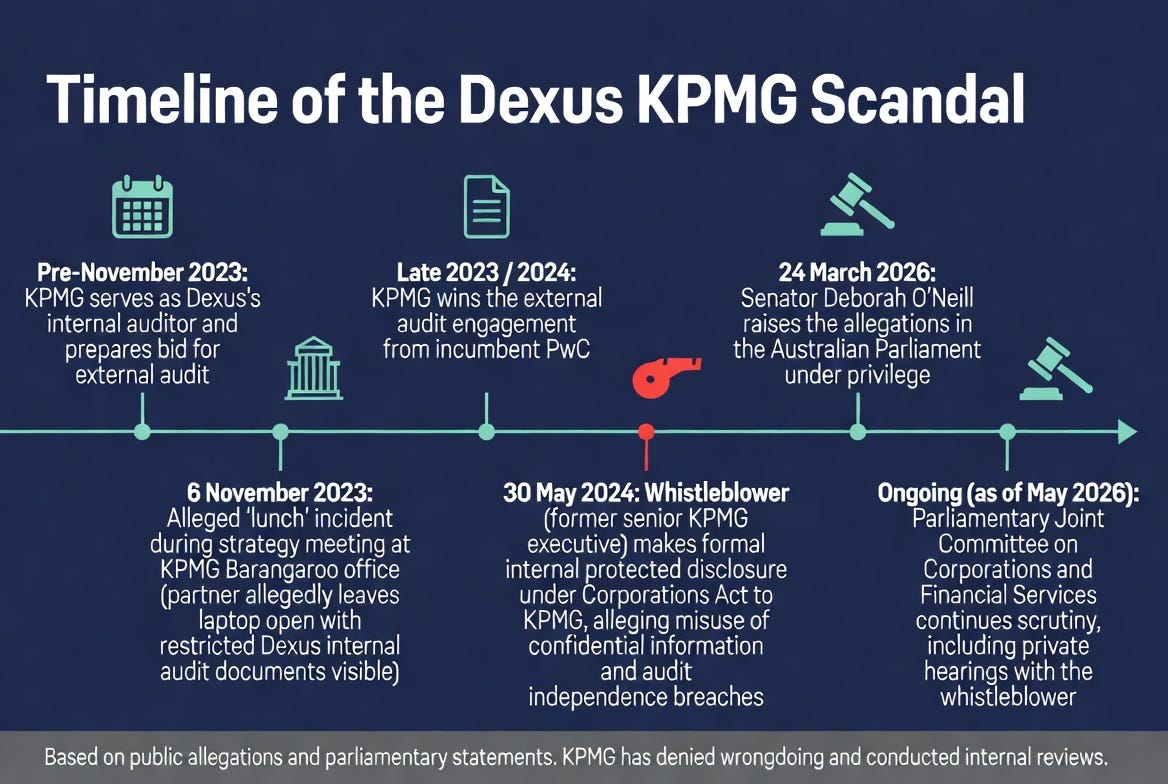
I wrote about this case in last week’s issue of Big Four News, but I will summarize it here for the sake of completeness.
KPMG had been Dexus’ internal auditor for several years, but when the company issued a call for tenders for their external audit, the partners were determined to expand their slice of the pie and bid for this work too – notwithstanding the fact that having the same firm conduct both the internal and external audits is not ideal because of potential independence issues.
The Dexus Audit Committee initially demurred, but they ultimately decided to allow KPMG to throw their hat in the ring, making it clear that they expected robust Chinese Walls to be put in place between the internal and external auditors, to ensure a level playing field for all bidders.
What did they get instead?
Allegedly, a war room led by audit partner Suzanne Bell, who is in a long-term romantic relationship with KPMG Australia Chairman Martin Sheppard - a relationship that has raised questions about potential conflicts of interest, both perceived and actual.
In one session, according to the whistleblower, an internal audit partner announced he was going for lunch and left his laptop open, displaying restricted Dexus information for the bid team to read.
KPMG ultimately won the $2.5 million engagement.
Client Betrayal - Optus and Telstra
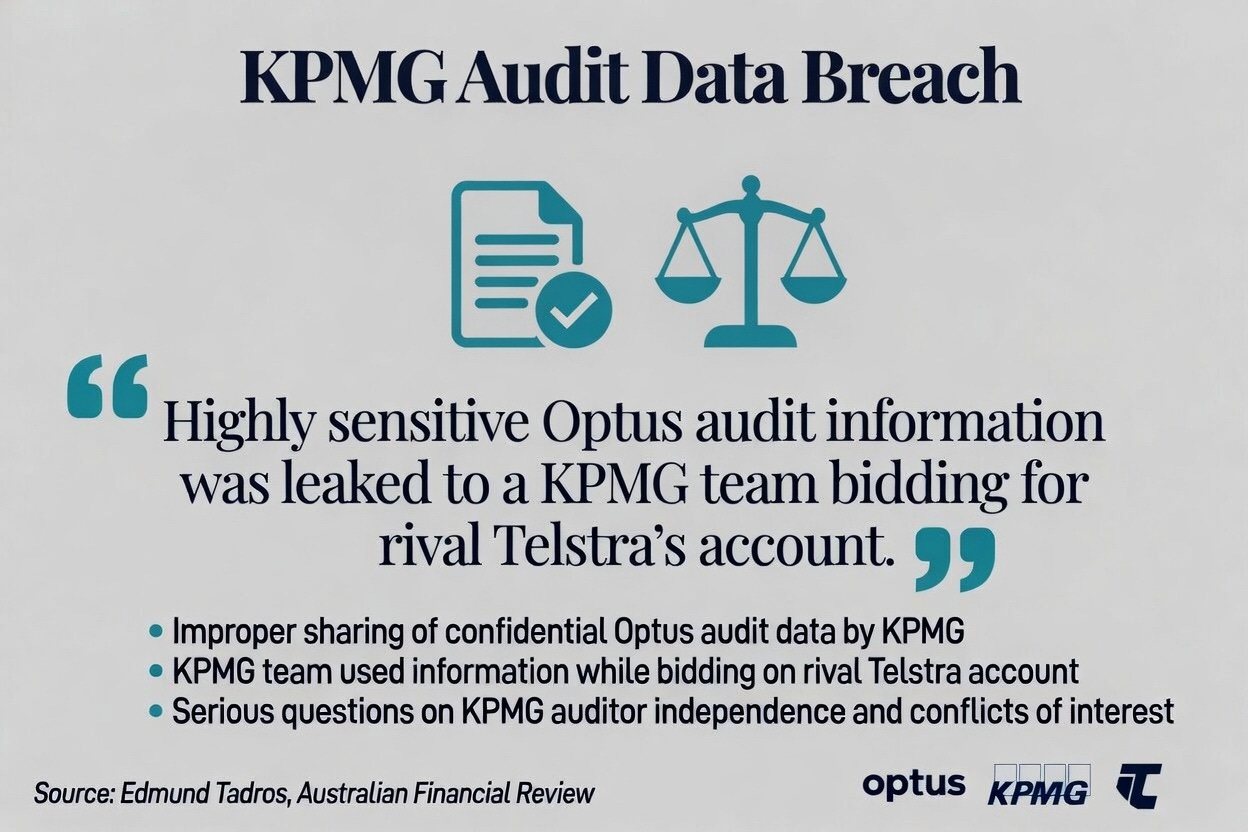
This case is, arguably, the most shocking of the three – because it involves an alleged betrayal of a loyal client that KPMG has audited for 34 years.
Once again we return to the tenders command centre, where a bid team was working on a proposal for Optus rival, Telstra.
According to the whistleblower (these claims were later confirmed by investigators from a law firm engaged by the KPMG board), Optus auditors shared highly sensitive, confidential information about their client with the team preparing the Telstra bid.
This time, the breach did not pay off. Deloitte won the engagement.
Rumblings about the Macquarie Group Audit
Details have not yet fully emerged regarding this case, but the whistleblower has alleged that KPMG leveraged internal information gained through its close connections — specifically via Michelle Hinchliffe, a Macquarie director and former senior KPMG audit partner (including former head of audit at KPMG UK) — to secure the audit tender.
The Macquarie Group audit is widely regarded as one of the most prestigious and lucrative mandates in the Australian and Asia-Pacific market. It is worth around A$75 million annually total fees — with the core Australian component around $30 million. KPMG’s successful bid to wrest the role from PwC in late 2025 was seen as a major strategic victory for the firm.
These remain unproven allegations at this stage, and further details are expected to surface as the Senate inquiry and regulatory probes continue.
Eileen Hoggett - Concert Tickets and … a Promotion to CCO
In the barrage of information that has emerged over the last week or so there were another two important titbits.
Eileen Hoggett - who we last mentioned in relation to the misappropriation of Lendlease board documents – reportedly accepted corporate box tickets to a Taylor Swift concert for herself and family members from Link Group, a major client where KPMG served as auditor.
The timing makes it particularly awkward. Link Group had faced a significant restatement in prior years following ASIC concerns over the valuation of its Funds Solutions business. This led to material adjustments to reported losses and a reduced profit outlook — events that directly hit investor confidence and share price.
While the Swift tickets themselves didn’t cause the restatement, accepting lavish hospitality from a client during such a sensitive reporting period raises legitimate questions: How objective can an auditor be when they (and their family) are enjoying corporate box perks courtesy of the company they’re supposed to scrutinise independently?
And finally, adding insult to injury, Hoggett was promoted to Chief Operating Officer of KPMG Australia after the firm had been alerted about her alleged improprieties by the whistleblower.
The Reckoning (So Far)
After weeks of relentless headlines, KPMG Australia finally blinked.
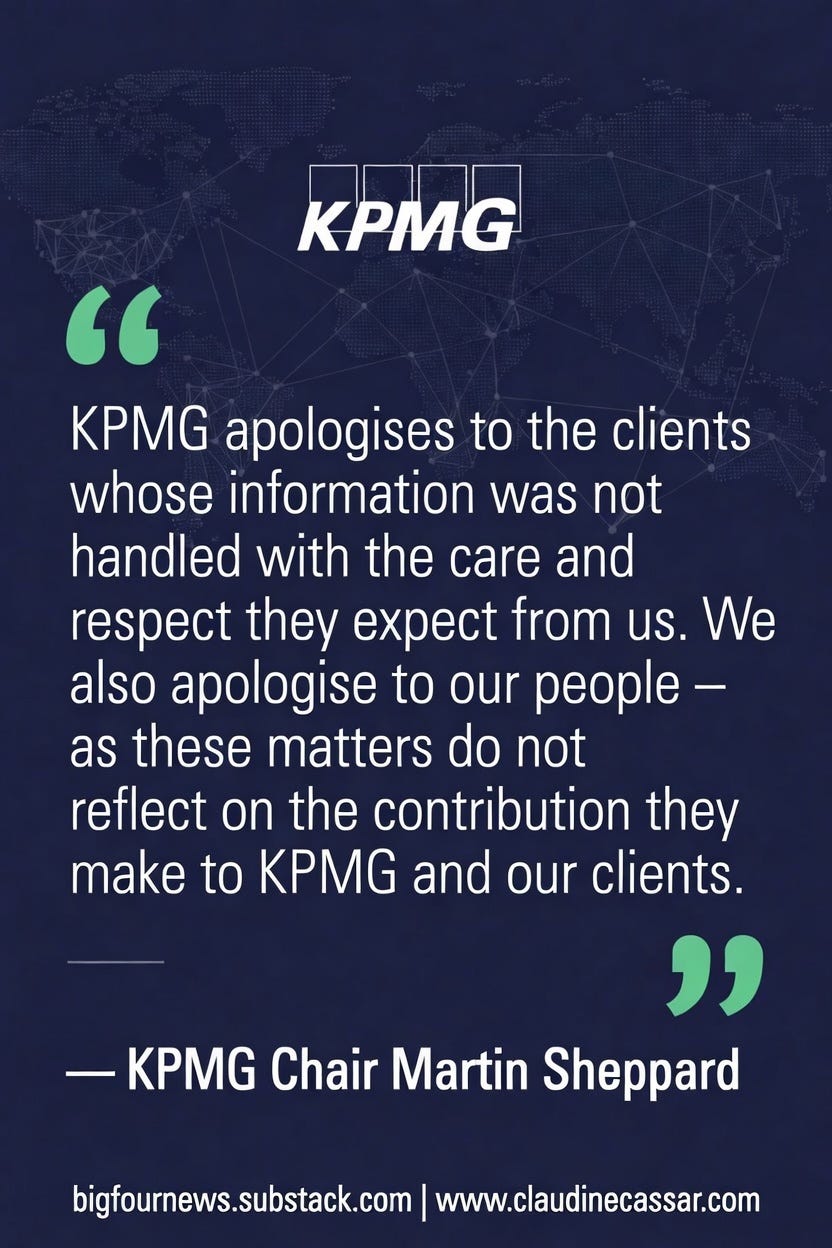
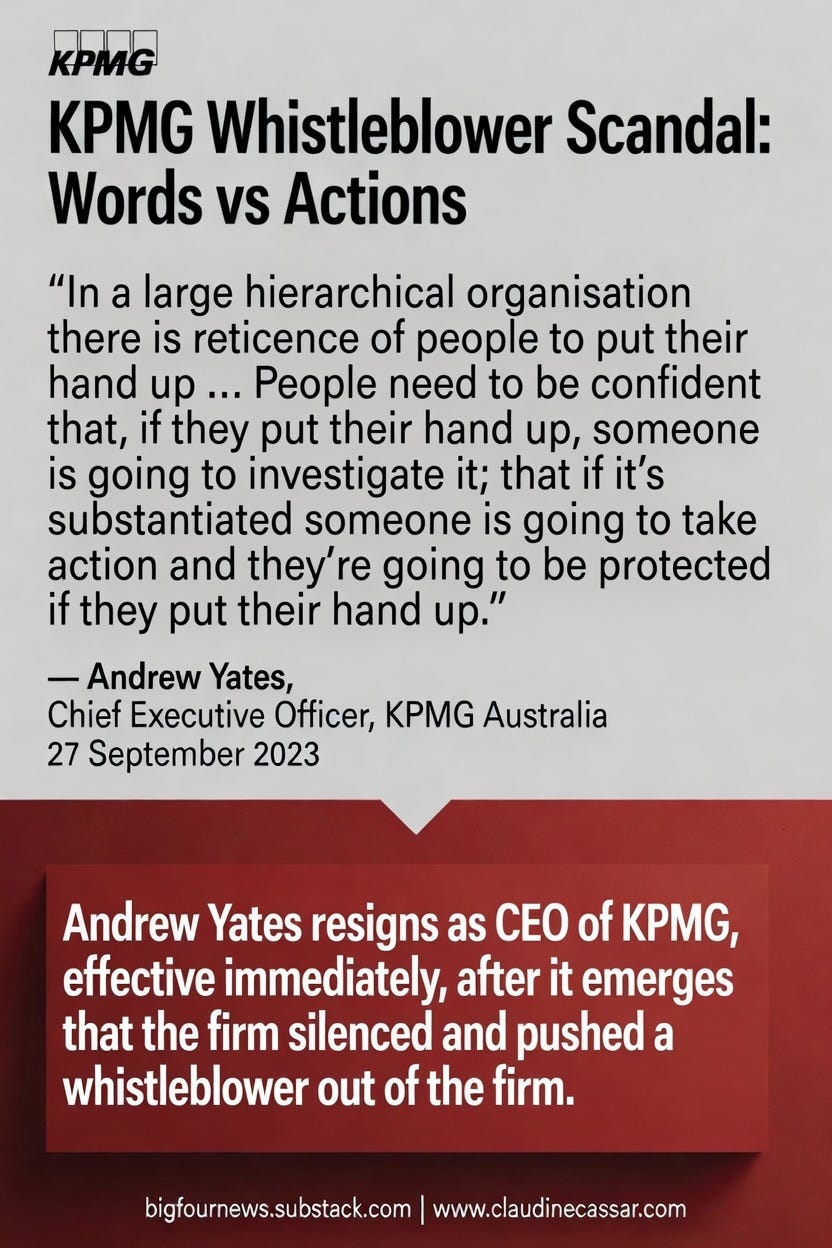
On May 29, the firm announced that CEO Andrew Yates and National Managing Partner of Audit Julian McPherson had both resigned, effective immediately. The Board appointed Stan Stavros, National Managing Partner of Deal Advisory & Infrastructure, as interim CEO.
In a statement that read like it had been lawyered within an inch of its life, KPMG admitted that its handling of the whistleblower and the subsequent investigations “fell short” of expected standards.
They’ve apologised — to the whistleblower, to their people, and to the broader community — and say they’re now reviewing everything from whistleblower protections to how they investigate serious complaints.
Some partners have already been sanctioned internally. It’s the closest thing we’ve seen to genuine accountability from a Big Four firm in Australia since the PwC tax leaks disaster.
Government Pushback
KPMG is undoubtedly hoping that having offered two of its most senior partners as sacrificial lambs will make the problem go away. That is unlikely. Senator Deborah O’Neill, who lit the fuse back in March with her parliamentary speech, shows no signs of letting this go.
She has been hammering the Big Four for years on audit quality, conflicts of interest, and cultural issues, and this scandal has given her plenty of fresh ammunition.
A Senate inquiry is now actively digging into the matter, with another public hearing scheduled for June 19. Expect more uncomfortable questions about not just KPMG, but the entire self-regulated ecosystem the Big Four have enjoyed for far too long.
The senator has made it clear she wants real structural change — not another round of corporate apologies, musical chairs at the top, and promises to “do better.”
Whether she gets it is another question. History suggests the Big Four are very good at surviving scandals. But this one feels different. The combination of multiple client breaches, a high-profile whistleblower, and sustained parliamentary heat has made this harder to contain.
KPMG’s attempts to contain the fallout have themselves come under scrutiny. The firm is now claiming legal professional privilege over key internal investigation documents, and has pushed for a closed-door parliamentary hearing. These moves are widely seen as efforts to shield partners and limit public accountability.
There’s also a growing risk that this scandal could hit KPMG where it really hurts — in the wallet. The Department of Finance has issued a blunt warning that the firm could be banned from bidding on Commonwealth government contracts after repeatedly failing to disclose the full extent of the whistleblower allegations to officials. This isn’t just embarrassing — it’s potentially existential.
KPMG partners are undoubtedly painfully aware of the precedent set three years ago during the PwC tax leaks scandal. When it was revealed that PwC partners had misused confidential government tax information to advise multinational clients on how to avoid new anti-avoidance rules, the consequences were swift and severe.
The firm was forced to sell its entire government consulting business to a private equity firm for a nominal $1 — a unit previously valued at well over $100 million and generating roughly $600–680 million in annual revenue.
Overall, PwC suffered a 26% revenue drop from $3.17 billion in FY2023 to $2.35 billion in FY2024, lost hundreds of partners and thousands of staff, and saw major client relationships erode. Partner remuneration was cut and public trust collapsed.
The parallels are stark. If KPMG faces a similar ban from new Commonwealth contracts the financial damage would be enormous, triggering reduced partner distributions, accelerated talent flight, further private-sector client defections, and long-term reputational damage that would be difficult to repair.
Criminal & Regulatory Investigations
On Friday, during a parliamentary hearing of the Joint Committee on Corporations and Financial Services, it was revealed that the alleged theft or misuse of confidential client documentation by KPMG personnel could constitute a breach of criminal law.
This marked a significant escalation, shifting the matter from primarily ethical, professional, and regulatory concerns into potential law-enforcement territory.
Meanwhile, the Australian Securities and Investments Commission (ASIC) has launched a preliminary investigation into the conduct of three registered company auditors at the firm.
ASIC Commissioner Kate O’Rourke confirmed the probe during the same parliamentary hearing. She explained that the regulator will focus on alleged misconduct involving the inappropriate sharing and potential use of confidential client information. Potential repercussions include cancellation or suspension of registration, fines, or other sanctions.
In my view, this narrow focus on individual partners risks missing the forest for the trees — the real issue is systemic and demands scrutiny of KPMG Australia’s culture, governance, and incentive structures as a whole.
That said, the regulator has not ruled out expanding its scope - so there might be some developments there.
Client Backlash
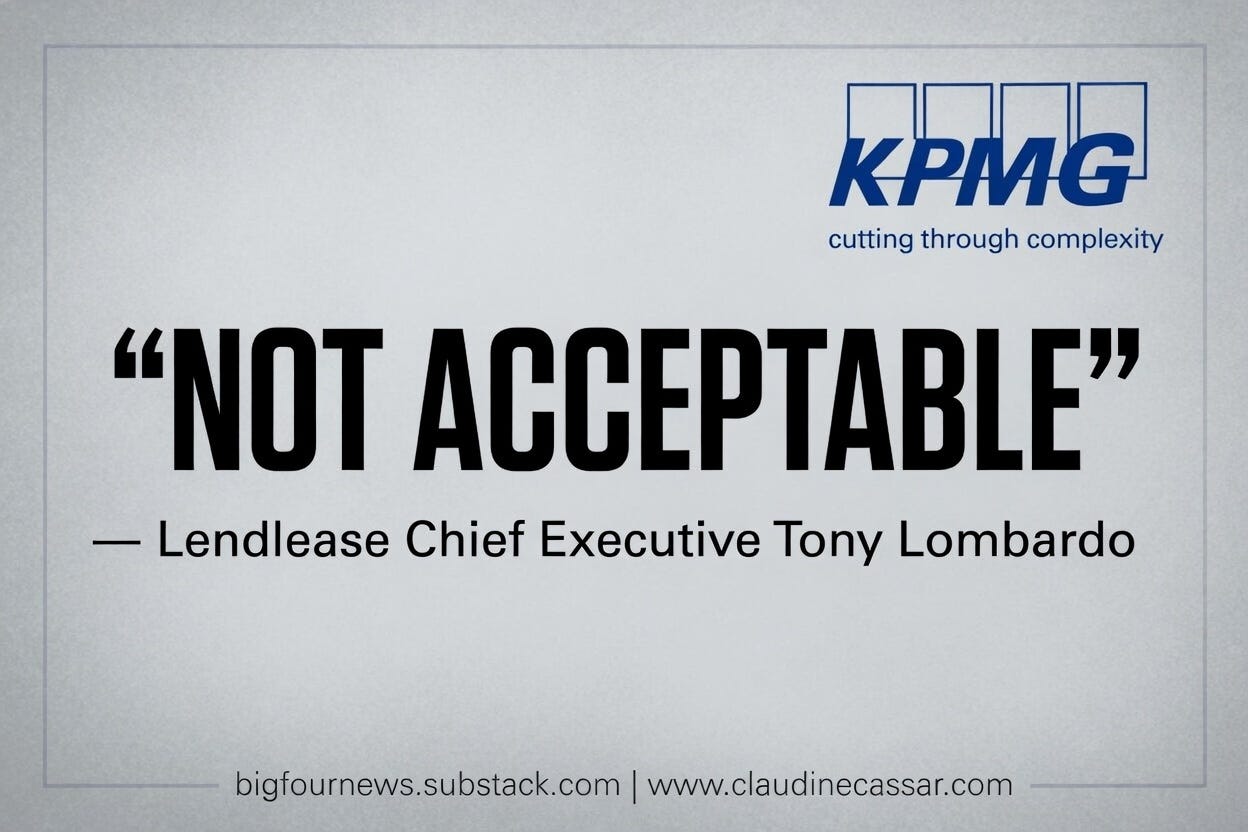
Client rumblings are also growing louder: Lendlease CEO Tony Lombardo described the firm’s actions as “not acceptable” in a letter to the parliamentary committee and confirmed the company is in active discussions with KPMG about next steps.
Earlier today Lendlease publicly stated that it is reviewing its audit services with KPMG and is actively beginning the process to change auditors.
Key quote from Lendlease (issued Monday, June 1, 2026)
“It is not appropriate to make a change in auditors this close to financial year end. We will be reviewing our audit services following the completion of FY26 reporting.”
In other words, Lendlease intends to end its 68-year audit relationship with KPMG. An ignominious termination which presages many other clients fleeing the firm.
Other impacted clients, including Optus and Telstra, have been formally notified of the breaches, while broader concerns continue to surface about the integrity of audits delivered to major Australian corporates.
The Decimation of Trust
The resignations may have been intended as a circuit-breaker, but the scandal’s ripple effects are widening. KPMG’s alleged breaches strike at the heart of private-sector confidence.
ASX-listed companies are particularly unsettled. Auditors are privy to the most sensitive board deliberations—strategy, mergers, financial forecasts—and the idea that this information could be weaponized for competitive pitches shatters the implicit trust that underpins the entire audit model.
There may also be significant ramifications for KPMG’s forensic department, which offers independent whistleblower reporting services to major clients through its “FairCall” service — a conflict that Senator Deborah O’Neill highlighted when she remarked that the discovery of institutions like the Reserve Bank of Australia and the ASX using the service “just blows my mind.”
A Tainted Culture
It’s good that two senior heads have rolled. The resignations of CEO Andrew Yates and audit chief Julian McPherson on May 29 were necessary, and the firm’s admission that its handling of the whole affair “fell short” is at least a start.
But let’s not pretend this cleans the slate.
The most uncomfortable question hanging over this scandal is not just what a handful of partners did — it’s how many people knew. Partners on the bids, employees in the war rooms, internal auditors who saw documents being passed around, senior leaders who signed off on narrow investigations… the list goes on.
Yet only one person had the courage to put their career on the line and speak up.
You can’t entirely blame those who chose to keep their heads below the parapet. They watched as the original whistleblower was labelled, sidelined, and eventually pushed out. The message sent from the top was crystal clear: rock the boat at your peril.
That’s the real cultural failure here.
When a professional services firm — one that lectures clients on ethics, governance, and whistleblower protections — creates an environment where employees are scared of calling out serious misconduct, something is deeply rotten.
The “eat what you kill” partnership model, the obsession with winning every pitch, and the cosy relationships at the top are not conducive to ethical behaviour - when all is fair in love and war, lines get crossed.
And here’s the longer-term worry: what are they teaching the next generation?
Younger partners and senior managers are being moulded by people who allegedly believe it is acceptable to rifle through a client’s confidential documents, breach Chinese Walls when it suits them, and treat uncomfortable questions as mere “employee grievances.”
Culture isn’t shaped by press releases and apologies. It’s shaped by what behaviour gets rewarded — and what gets punished.
Until KPMG (and the rest of the Big Four) confront this properly, we’ll likely see more of these scandals. Because the real problem isn’t a few rogue partners. It’s a culture that made their behaviour feel normal.
This scandal has the potential to be a turning point. Whether it leads to genuine structural reform or another cycle of apologies and minimal change will depend on sustained pressure from regulators, parliament, and clients.
Based on public reports and parliamentary records. Some matters remain under investigation.