

McKinsey’s Project Acorn
A Canary in the Coal Mine for the Consulting Industry

The consulting world is undergoing a profound transformation, and the latest move by McKinsey & Company offers a rare window into how the industry is preparing for it.
According to a Financial Times report, McKinsey is implementing an internal overhaul codenamed Project Acorn. The firm is shifting a larger portion of partners’ profit distributions from immediate cash payouts to equity. This change is designed to strengthen the firm’s capital reserves while adapting to more volatile, performance-linked revenue streams.
Why Is This Happening?
The consulting industry’s traditional economic model — high-margin, time-based billing — is under pressure from multiple directions:
Outcome-Based Pricing is Becoming the Norm. Clients, especially large enterprises, are no longer willing to pay premium rates simply for hours worked. They are pushing for “success fees” based on metrics such as savings or productivity improvements.
Artificial intelligence is also dramatically accelerating project timelines and reducing the need for large teams of junior consultants who once formed the backbone of billable hours. What used to take months of on-site analysis can now be supported (or in some cases replaced) by AI tools. This creates both opportunity and revenue uncertainty.
To stay ahead, firms must invest heavily in proprietary AI platforms, data capabilities and industry-specific solutions. Holding more capital internally gives leadership greater flexibility to make these bets without relying on external debt or diluting ownership.
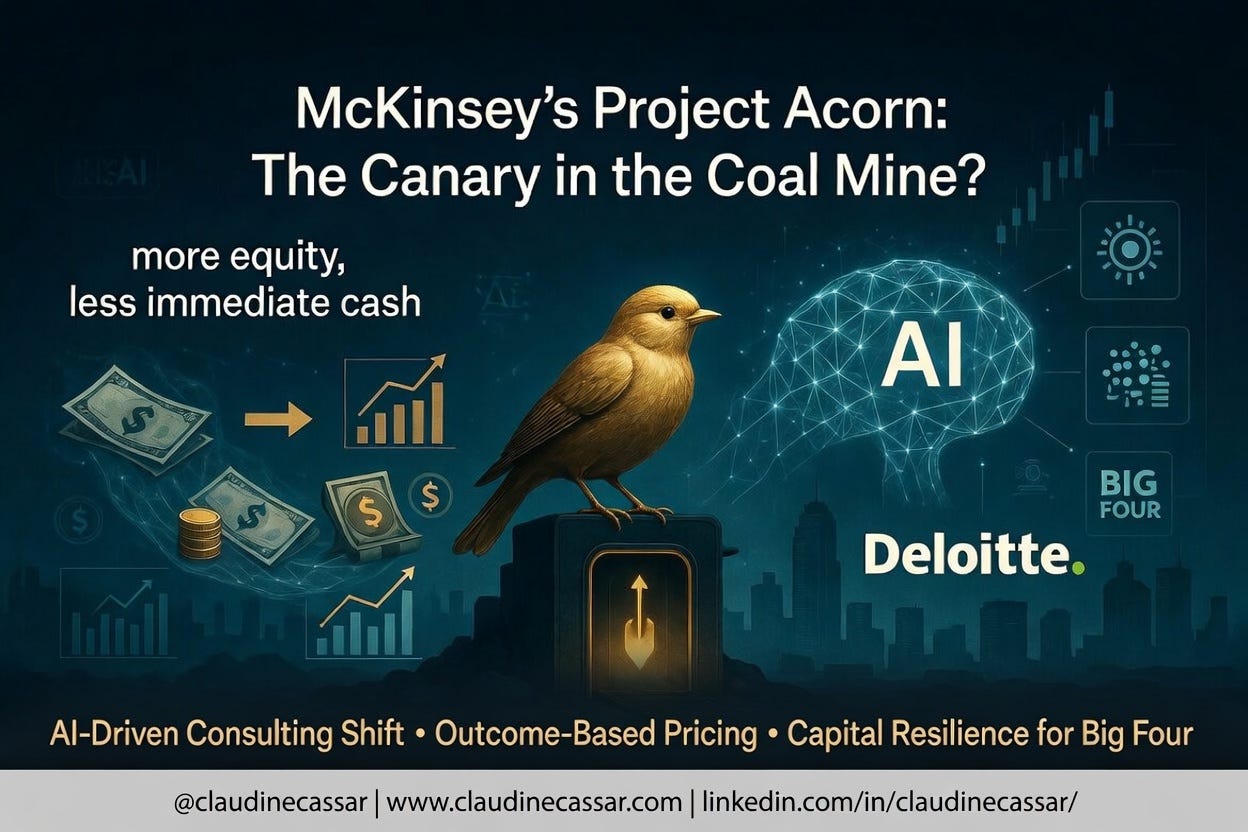
The Big Four Angle — Especially for Deloitte
McKinsey may well be the canary in the coal mine.
While McKinsey operates as a pure-play strategy and management consultancy, the Big Four have broader service portfolios — but consulting is a large chunk of their annual revenue.
Deloitte stands out in particular. Roughly two-thirds of its global revenue now comes from consulting and advisory work. This makes the firm highly sensitive to changes in pricing models, AI disruption of traditional delivery, and the capital requirements needed to compete at the highest level.
The four firms are investing billions of dollars on talent, tools and intellectual property — investments that are harder to fund if cash flows become lumpier due to outcome-based contracts.
Shifting more partner compensation toward equity is an elegant solution: it builds a stronger internal capital base without raising outside money or cutting distributions too aggressively. It also better aligns partner incentives with the firm’s long-term health.
AI has already upended the traditional pyramid leverage model of the firms. Clearly, partner compensation is next.