

KPMG UK Ends Summer Friday Perk Amid Redundancies and Record Partner Pay
Redundancies, poor internal communication and the removal of a popular summer perk are hitting staff morale as partner payouts reach a record £880,000.

Key Takeaways
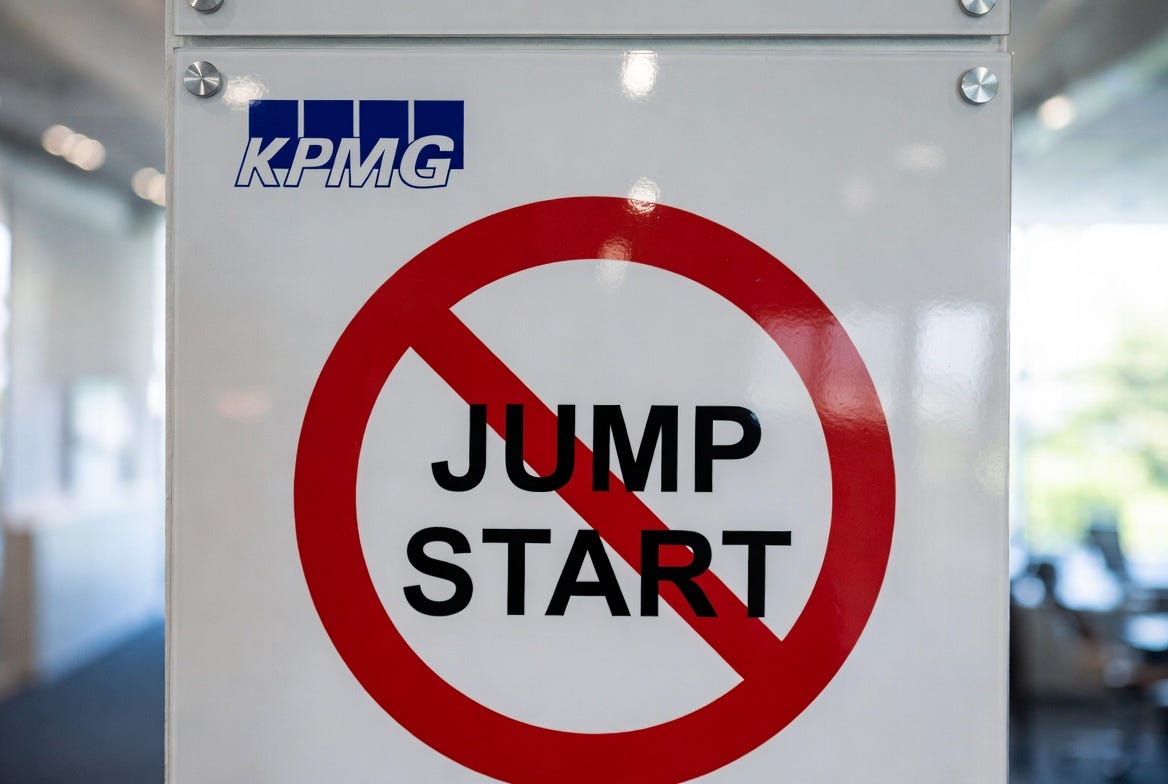
KPMG UK ends its summer Jump Start early Friday finish programme
The change follows a redundancy round in which nearly 600 UK employees were told their jobs were at risk
Staff report significantly longer hours and increased pressure following headcount reductions
Partners recorded record average distributable profit of £880,000 for the year ended September 2025
Earlier pay and bonus reductions (2023 and 2025) followed by removal of a valued flexibility perk
PwC continues a (reduced) summer Friday policy, highlighting variation in approach across the Big Four
KPMG UK has ended its popular summer “Jump Start” early Friday finish programme. The benefit, introduced in 2021 as a Covid-era wellbeing measure, allowed staff to finish 2.5 hours earlier on Fridays through the end of August — provided they logged a full 40-hour week by working more hours on other days.
A spokesperson for the firm said:
“Every year we review our summer ‘jump start’ programme to make sure we are considering market conditions and business needs.”
The change affects roughly 16,700–17,000 people across the UK.
The question at this stage is: What does the removal of this perk — coming shortly after nearly 600 redundancies (mostly in audit) and the highest average distributable profit per partner on record — reveal about how KPMG UK is balancing short-term cost discipline against longer-term organisational health and culture?
To answer that, it helps to look at the sequence of events and the signals they send about priorities and trust inside the firm.
Redundancies and Poor Communication at KPMG
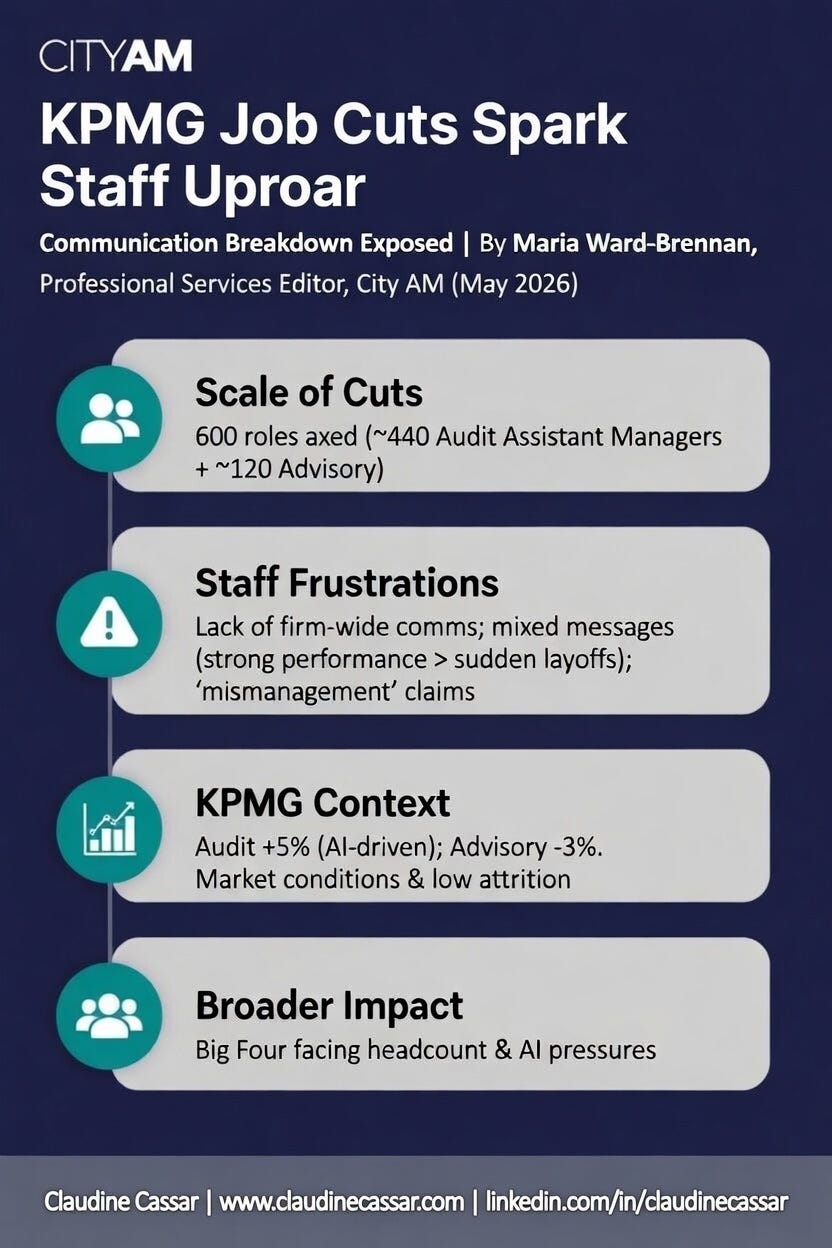
In late March 2026, KPMG UK announced plans to cut around 440 assistant manager positions in audit — roughly 6% of the audit division’s 7,100-strong workforce — along with 120 roles in advisory.
The problem with the announcement was not just the scale of the cuts, but how they were communicated.
Staff described a fragmented process, with news of the advisory cuts emerging first and the larger audit reductions only becoming clear later through external reporting.
There was no clear, firm-wide communication explaining the rationale.
Anonymous sources inside the firm expressed frustration:
“We only got [news of] the advisory side, so when the news came out that it was 600 jobs…oh, audit has been hit as well.”
“KPMG didn’t do like a firm-wide email being like ‘this is what’s happening with the firm’.”
“There has been a lot of ‘mismanagement’… one minute, there is an email saying the business is doing well; the next, there is an email saying people will be laid off.”
Source: CityAM
The result has been widespread anger and a sense that leadership failed to treat people with basic respect during a difficult process.
A Sector-Wide Adjustment after the Post-Covid Hiring Surge
KPMG is not the only firm to lay off staff in the UK over the last year or so. On June 16 (just days ago), Deloitte announced it is offering voluntary redundancy packages to up to 175 auditors in its audit and assurance practice. PwC and EY have also “right-sized” by reducing headcount.
In each case the firms cited:
Low attrition — The recent economic uncertainty reduced the natural turnover that firms normally rely on to manage headcount.
Softer demand in parts of the business — Clients have become more cost-conscious. Audit has been resilient but still faces pricing pressure and efficiency demands.
Cost discipline and margin protection — The firms are managing their P&L through careful cost management.
Shift toward efficiency and new priorities — Investment in AI and technology is a deciding factor when reducing headcount.
That said, while these pressures are common across the Big Four, the way individual firms chose to manage headcount reductions, communicate change, and balance cost control with staff flexibility and wellbeing sent quite different signals about their organisational priorities and culture.
A Heavier Workload For Those Who Remain
Assistant Managers are central to audit delivery — handling fieldwork, reviewing junior work, and managing client relationships — so the reduction of headcount in this crucial role will inevitably put significant additional pressure on those who remain.
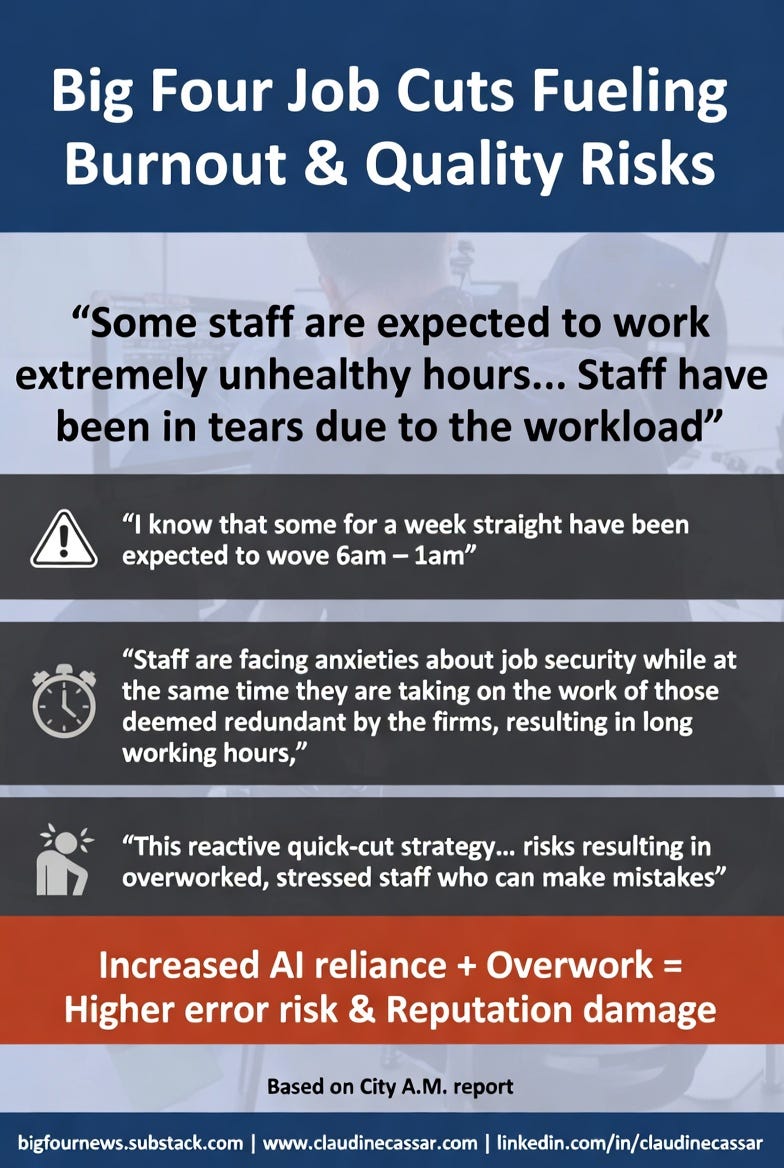
Reporting by CityAM on job cuts across the Big Four in the UK found that staff in audit departments have been expected to absorb the workload of colleagues who were made redundant. This has led to significantly longer working hours.
One source described situations where staff were working from 6am until 1am for days at a time, with some reduced to tears under the strain. Many expressed concern that the pressure would intensify further.
By removing Jump Start, KPMG eliminated one of the few formal mechanisms allowing staff to avoid working the same long (and often unpaid) hours on Fridays that have become common across the rest of the week.
The impact is not just burnout. People who are consistently working under this level of pressure are at a higher risk of making mistakes and taking shortcuts — directly affecting audit quality.
Record Partner Earnings
What makes this situation difficult to reconcile is that KPMG UK partners have just banked their biggest payday ever.
For the year ended 30 September 2025, the combined KPMG UK/Swiss Group reported revenue of £3.6 billion (up just 2%), but profit before tax jumped 14% to £576 million.
Average distributable profit per partner rose 11% to £880,000 — the highest level on record.
The firm itself credited “careful cost management in response to the economic cycle” and a continued “focus on managing costs” amid headwinds and lower attrition.
The same pattern appeared the previous year: modest revenue growth paired with double-digit profit increases driven by cost discipline.
In other words, while staff have faced redundancies, reduced flexibility, and what many see as tone-deaf internal communications, partners have enjoyed their strongest financial year yet.
Earlier Cost Cuts: Pay Freeze and Bonus Reductions
This is not the first time KPMG UK staff have been asked to absorb cost cuts while partners banked record gains.
In late 2023, the firm froze salaries for around 12,000 UK workers (except promoted staff) and reduced bonuses; staff in the tax and legal division received only 55% of their target bonus for the year.
At the time, KPMG cited the same rationale it is using now — “market uncertainty.”
Then in October 2025, KPMG cut pay for staff in Band 2 offices (Reading, Watford, Cambridge, Oxford), removed annual salary adjustments, and scrapped “recharges” — which means that they stopped paying staff for overtime when they worked over 50 hours in any given week.
The removal of Jump Start may seem small in isolation. But when stacked on top of a messy redundancy round, earlier pay freezes and bonus cuts, and record partner earnings, the decision raises questions about how the firm is prioritising different stakeholder interests.

KPMG vs PwC on Summer Fridays
It has also probably not gone unnoticed by KPMG staff that PwC – presumably facing the same “market conditions” – is still running its own summer Friday policy this year.
PwC employees can finish at lunchtime on Fridays from 20 July to 28 August, though the window has been trimmed from 12 weeks to six.
The Impact on KPMG Culture
Beyond the immediate operational pressures, the combination of decisions made by senior leaders at the firm — large-scale redundancies in audit, poor internal communication, earlier pay and bonus reductions, and now the removal of a visible wellbeing perk — carries cultural significance.
In organisational terms, these moves function as signals about what (and who) the firm values most.
When a firm publicly frames cost discipline as necessary for long-term sustainability while simultaneously removing one of the few formal mechanisms that gave staff permission to step back from extended hours, it risks eroding the psychological contract — the unwritten understanding of mutual obligation between the organisation and its people.
This matters, because professional services firms like KPMG rely heavily on discretionary effort, trust, and a sense of shared identity to deliver complex, judgement-based work such as audit.
When repeated actions appear to prioritise partner returns and cost control over the conditions that sustain staff commitment and professional scepticism, the cultural fabric of the organisation can begin to fray.
Over time, this can manifest not just in higher turnover, but in quieter forms of withdrawal — reduced willingness to go the extra mile, weaker identification with the firm, and a more transactional relationship between professionals and the partnership.
So the longer-term risk for KPMG UK lies not only in potential impacts on audit quality and retention, but in whether the firm can sustain the high-trust, high-commitment culture needed to attract and retain talent while navigating technological change and regulatory expectations.