

Whistleblower Hotline to Nowhere
KPMG International Declined to Investigate 17 Allegations from Australia

Key Takeaways:
Yates and McPherson out; Stavros (TAHE-linked) in as interim CEO
Chairman’s long-term partner ran the internal bid “war room” — optics problem
Lendlease reviewing 68-year relationship; Dexus blocking Hoggett; governments issuing warnings
ASIC formal investigation underway; partners exiting (global has frozen departures)
The KPMG storm in Australia shows no signs of abating. This edition builds on last week’s ‘Chaos Down Under,’ so if you still haven’t read it, I recommend starting there before diving into this one.
Reading that edition will bring you up to speed on the mishandled whistleblower complaint and the litany of misbehaviour by senior KPMG partners — from the hiding of illicitly obtained Lendlease board papers in a locker, to the Dexus Lunchgate laptop leak and the Optus data breach, and even a partner accepting Taylor Swift concert tickets from a client.

This week has seen several important new developments emerge.
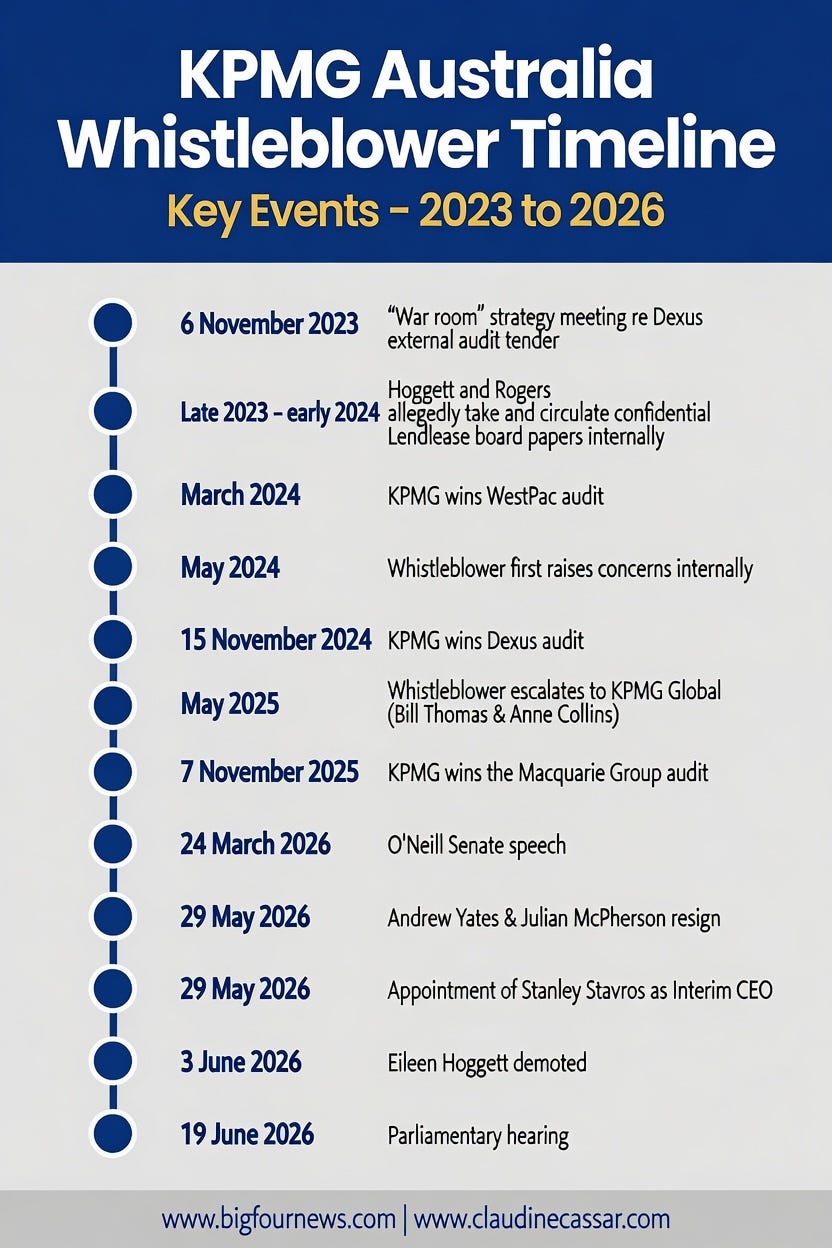
Eileen Hoggett has been demoted from chief operating officer, though she remains an audit partner. The whistleblower — a former KPMG Audit Director — accused her of misappropriating confidential Lendlease board papers, including pitch decks submitted by rival firms.
The board overruled recommendations from chief legal counsel Louise Capon and head of people Dorothy Hisgrove for a significantly tougher penalty following the firm’s internal investigation and an external review by Ashurst, opting instead for her demotion from the executive role.
Notably, she has not resigned from the firm, even after Dexus refused to allow her to sign its financial statements. Some observers have speculated that she may still be negotiating her exit package — particularly after former CEO Andrew Yates reportedly received a retirement payout of around A$2.9 million.
Paul Rogers, the second audit partner accused of misusing confidential board documents, has been stood down from key client accounts. This means he can no longer act as the signing auditor on those engagements.
Jeff O’Sullivan, Head of Internal Audit Services, who is implicated in the Lunchgate allegations, has received a sanction, though the details have not been disclosed.

Consequences Mount: Regulatory Scrutiny and Institutional Damage
The fallout from this scandal is accelerating rapidly. Lendlease has placed its 68-year audit relationship with KPMG under review and is widely expected to terminate it once current financial year reporting concludes.
Westpac is considering re-tendering its audit work, just two years after awarding the mandate to KPMG. The bank is also reportedly pushing the firm to contribute to the multimillion-dollar costs of the tender process.
NSW Treasury Secretary Michael Coutts-Trotter sent a formal letter to KPMG demanding assurances that the firm did not mishandle confidential government information, while the Victorian government has placed its contracts with KPMG under review over data misuse concerns.
The Department of Finance has explicitly warned KPMG that it could be banned from bidding for new Commonwealth contracts due to repeated failures to disclose serious internal allegations of client data misuse.
The Reserve Bank of Australia has confirmed it will re-tender its whistleblower hotline contract, which ironically is currently run by KPMG.
Assistant Treasurer Daniel Mulino has also indicated that recent events have brought previous recommendations for reforming the professional services sector back on the table – so the debacle is now likely to also hit PwC, Deloitte and EY.
And there is also ASIC’s formal investigation underway and a parliamentary hearing on 19 June for the firm to reckon with.
No wonder so many partners are trying to leave. The exodus has accelerated to such a point that KPMG International has reportedly stepped in to block exits, amid concerns that the firm could soon run short of auditors needed to meet its obligations.
Musical Chairs at KPMG: Stan Stavros and the Leadership Credibility Crisis
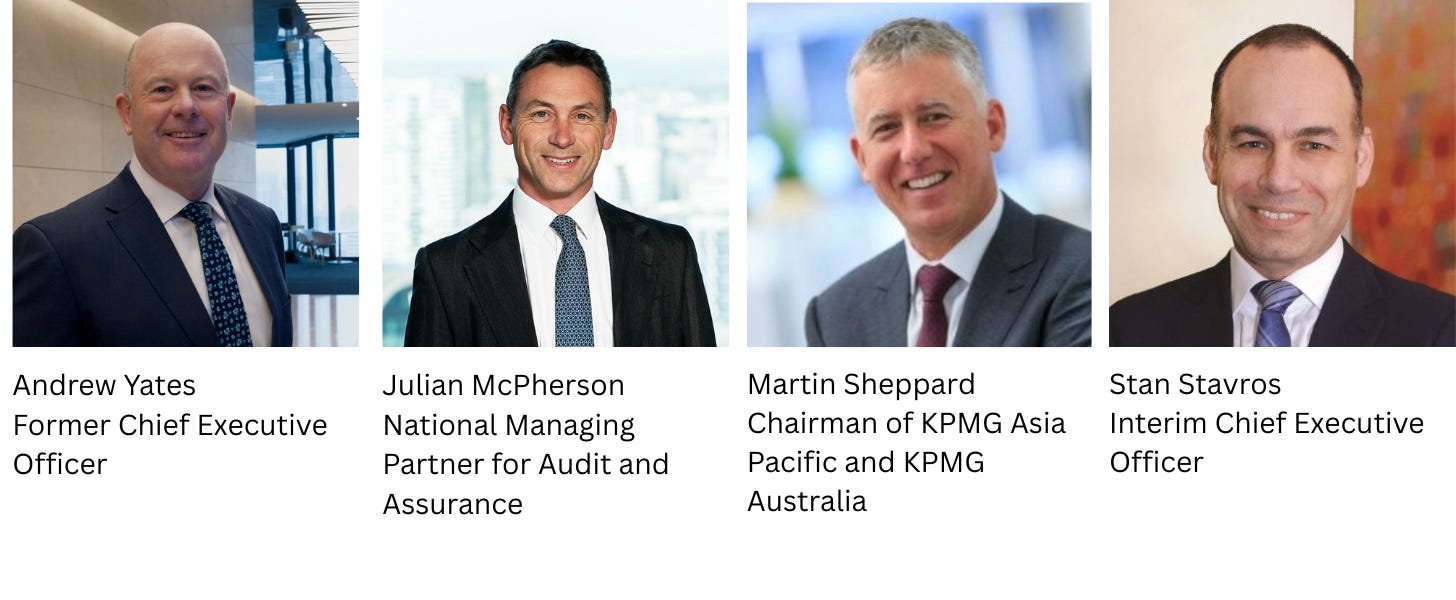
After Chairman Martin Sheppard accepted the resignations of CEO Andrew Yates and National Managing Partner for Audit and Assurance Julian McPherson, the national board appointed Stan Stavros — formerly the National Managing Partner for Deal Advisory & Infrastructure — as interim CEO.
The selection of Stavros is puzzling. How does it make sense — and what message does it send — to replace Yates with a senior partner who was closely associated with the firm’s previous major whistleblower controversy, the Transport Asset Holding Entity (TAHE) affair?
In an email to partners, the interim CEO emphasised:
“I come to this role not having been involved in the whistleblower process, but it is clear to me that we should have handled things differently. I am 100 per cent committed and will ensure we approach the issues in the right way.”
While it may be technically true that Stavros was not directly involved in the current scandal, his senior leadership role during the earlier TAHE scandal seriously undermines his credibility to champion better internal whistleblower practices and governance standards.
Brendan Lyon, the former KPMG partner who raised serious concerns about alleged accounting improprieties, potential conflicts of interest in dual-client advice, and significant public safety risks stemming from the proposed structure and rushed implementation of the railway project, named Stavros under oath as one of the executives he escalated his concerns to.
In 2021, Lyon was subpoenaed to appear and produce documents during the public inquiry into TAHE. He submitted extensive evidence to substantiate his claims that he had been bullied and pressured to modify his conclusions about the rail development — including an SMS chain with his boss, Stan Stavros.
In a written submission to the committee in January 2022, Lyon stated:
“Sadly, despite repeated reports of my poor treatment and explicit discussion with Mr Stavros about the ethical and potentially legal breaches by KPMG personnel and others, Mr Stavros expressed that he couldn’t help due to the seniority of the personnel involved and that he was Melbourne based.”
Over a year later, on 6 September 2023 — by which time he had been appointed Professor of Practice at the University of Wollongong’s Faculty of Business and Law — Lyon appeared again before the Public Accountability and Works Committee. The following extract from his testimony, where he talks about KPMG’s internal whistleblower policy, is particularly telling:
“I made countless written reports under that policy, including to the CEO, Andrew Yates; ... the head of my practice group, Stanley Stavros, now on the national executive committee of KPMG; and, of course, to my second partner, Paul Low, KPMG’s head of government, who appeared before you yesterday.”
Lyon’s sworn testimony paints a concerning picture of a senior leader who, when confronted with serious internal ethical concerns, chose not to intervene, citing hierarchy and geography as reasons for inaction. Such a response sits uncomfortably with Stavros’s current assurance that he will “approach the issues in the right way.”
The decision to appoint a partner tainted by prior association with inadequate handling of whistleblower concerns, in a scandal that caused KPMG significant reputational damage, suggests one of two uncomfortable possibilities: either the board is poorly informed about the firm’s recent history, or the partnership lacks sufficient untainted leadership talent to offer a cleaner break from the past.
Conflicts of Interest on the KPMG Board
This situation is further complicated by a significant perceived conflict at the very top of the firm.
Chairman Martin Sheppard is in a long-term romantic relationship with KPMG audit partner Suzanne Bell, who led the firm’s internal “war room” — a dedicated team working on bids to win new audit engagements.
According to the speech given under parliamentary privilege by Senator Deborah O’Neill on March 24, the whistleblower reported that during one of these tender strategy sessions:
“On 6 November 2023, a meeting was held at KPMG’s Barangaroo office … during that meeting, and despite acknowledged independence sensitivities, an arrangement was proposed where (one of the people present) would leave his laptop open with Dexus internal audit documents visible while he went for lunch, allowing external audit personnel to view them.”
The person who strategically took off for lunch was the head of internal audit services, Jeff O’Sullivan. KPMG admits that he indeed made the problematic comment, but classified it as an “inappropriate remark” and a “joke” — although this is then put into question because O’Sullivan was sanctioned internally for his behaviour.
The whistleblower has stated that the comment was not made in jest. He claims it was intended to allow the team working on the Dexus tender to view confidential client information.
Notably, when external lawyers were brought in to investigate the allegations in 2024, they did not speak to anyone else who had been present in the room. This may help explain why the investigators concluded there was no evidence to support the whistleblower’s claims.
Whatever the context of the comment in question, there can be no denying that O’Sullivan’s very presence in the room where the bid was being drafted was improper, raising serious questions about the independence protocols and Chinese walls at KPMG, particularly given Dexus had received assurances that robust safeguards were in place.
And while there has so far been no indication that Bell is implicated in these events, her presence is uncomfortably close to many of the confidentiality breaches that the firm is currently being accused of.
Given these circumstances, Sheppard’s central role in accepting resignations and appointing Stan Stavros invites legitimate questions about impartiality. At a time when the firm’s governance is under intense scrutiny, optics matter. KPMG cannot afford even the slightest perception that personal and partner relationships may be influencing key leadership decisions.
The KPMG board recently launched a fourth investigation into the whistleblower’s claims. However, this was not initiated by Chairman Martin Sheppard. It was forced through by its three independent directors at the time — Jane Hemstritch, Patty Akopiantz, and former NSW Premier Mike Baird — after the whistleblower contacted them directly and insisted the matter be properly examined.
Mike Baird stepped down from the board in September 2025. Reports indicate his resignation was driven by frustration with the firm’s initial handling of the whistleblower complaints and the lack of decisive action, as well as the role being restructured to require meetings in Singapore.
After his departure, the board — rather than making a clean break and engaging a legal firm with no prior involvement — re-appointed Allens, the same firm whose earlier investigation KPMG had admitted “lacked rigour.”
The Allens investigation remains ongoing.
KPMG International’s Abdication of Responsibility
The whistleblower first raised concerns internally in 2024. After the firm’s initial reviews found no evidence of wrongdoing, he escalated the matter to KPMG International in 2025.
According to reports in the Financial Times, he even emailed Bill Thomas, the International Chair and Chief Executive of KPMG, and Anne Collins, the KPMG Global General Counsel, describing the unethical behaviour that he had witnessed in the Australia firm.
The correspondence continued for months — the AFR reports that it viewed emails dated August 2025 in which the whistleblower described 17 separate allegations — but in the end he was told that it was not within KPMG International’s remit to investigate these claims, and they washed their hands of the entire affair.
The problem with this excuse is that KPMG operates an International hotline specifically for such situations:
“for KPMG personnel, clients and other third parties (such as suppliers, contractors, sub-contractors, external consultants, alliance partners, or other third party resource) to confidentially report concerns they have relating to certain areas of activity by any KPMG International entity, activities of KPMG firms or KPMG personnel.”
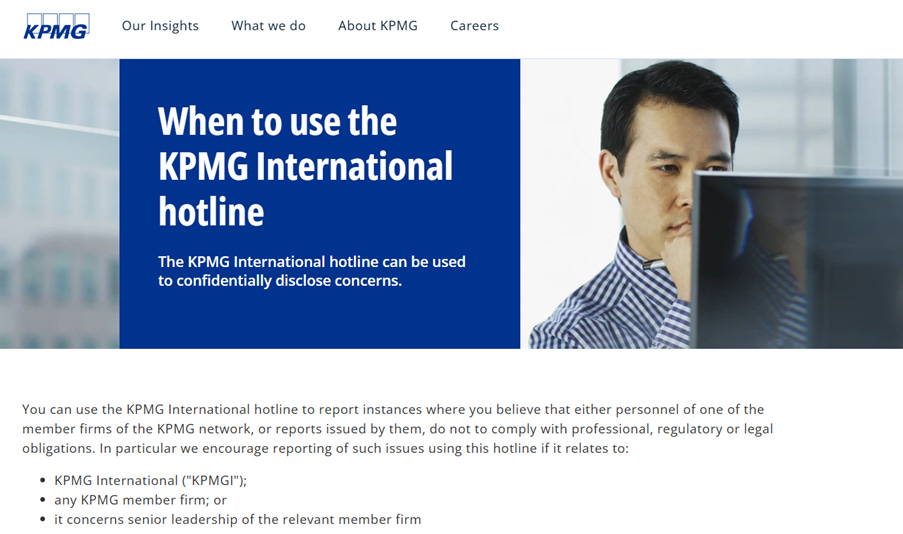
This begs the question — what on earth is this whistleblower hotline for if employees who make serious reports are then told that nothing can be done because the global entity has “no control” over the local entities?
This was not the first time that KPMG International failed employees who used this hotline, and also not the first time that Bill Thomas ended up in the limelight for ignoring multiple whistleblower reports made by KPMG staff.
In 2022 the Financial Times reported that employees in KPMG UAE had filed multiple complaints about the behaviour of the local CEO, Nader Haffar — both in writing and via the hotline — over the previous three years.
The FT article includes the following quote from an email sent by a KPMG employee to Bill Thomas in 2022:
“Many of us ask how we can credibly advise clients and provide assurance to shareholders, when our own leadership fail to uphold our most basic values which we broadcast as being sacrosanct.”
Clearly, the mishandling of whistleblower allegations is endemic — and dare I say it, systemic by design — in the firm.
Out With the Old and In with the New
Bill Thomas is now in the final months of his term as International CEO and Chair and will be replaced on October 1 by Gary Wingrove.
Mr Wingrove was the CEO of KPMG Australia while the Brendan Lyon case was playing out, so the concerns I expressed above about Stan Stavros also apply to him.
The following is a page from Prof Lyon’s submission to the parliamentary commission in 2021, where he alleges that Wingrove attributed the saga that the exiting partner had gone through to the fact that he had not been properly integrated within the firm.
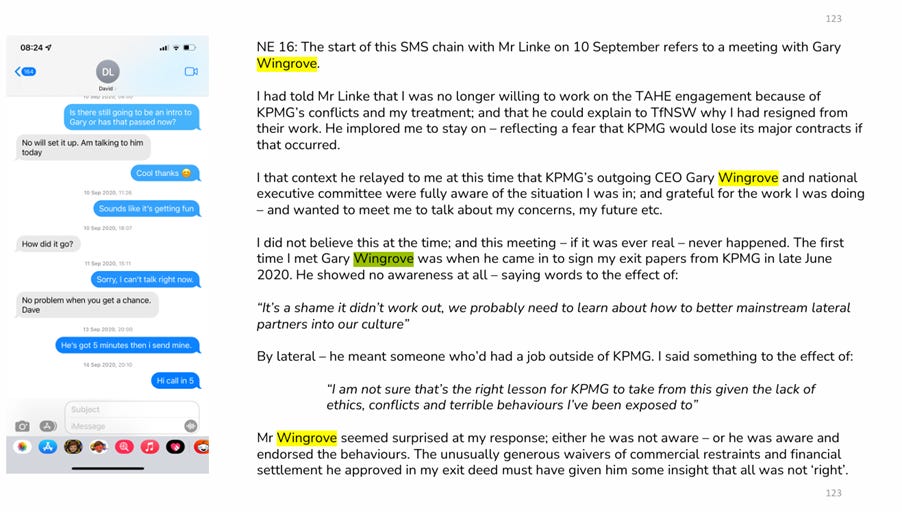
This exchange is very telling. As an anthropologist, and a lateral hire myself (I entered Deloitte as a non-equity partner in 2016, after selling them my two technology companies), Wingrove’s comment hits the nail on the head.
This is what corporate culture is about — the things that are understood between the lines. The stuff that is left unsaid. The actual priorities of an organisation, as opposed to the ones they trumpet on brochures and websites.
Wingrove was right — the whole kerfuffle with Lyon had happened because he had not fully integrated the culture of the firm into his professional identity yet.
Most of the partners in the Big Four are lifers, not lateral hires, and in the main they would have spent their entire career at the firms — straight out of school. The modus operandi of the firm they end up dedicating their professional life to becomes part and parcel of their identity as professionals, and the priorities of the firm become their own.
When a firm places heavy emphasis on revenue growth while only paying lip service to ethics and integrity, many partners absorb those priorities without much conscious resistance. It simply becomes “the way things are done.”
It is therefore no accident that the majority of whistleblowers are lateral hires or relative newcomers — they are the ones who experience the cognitive dissonance between what firm leaders do and what they say.
At this critical juncture, KPMG Australia needs more than another internal reshuffle. It requires credible leadership untainted by previous controversies — people with the independence and moral authority to drive genuine cultural reform and rebuild client trust.
Based on public reports and parliamentary records. Some matters remain under investigation.